
Wire tension in coil winding: from offline checks to inline monitoring
Wire tension is checked with the machine stopped. But what happens when it starts running? Dragonfly® turns the winding machine itself into a measurement system: from offline checks at 2 N to inline monitoring at 0.05 N.
Before
2N
Manual check · at rest
With Dragonfly®
0.05N
Live · in production
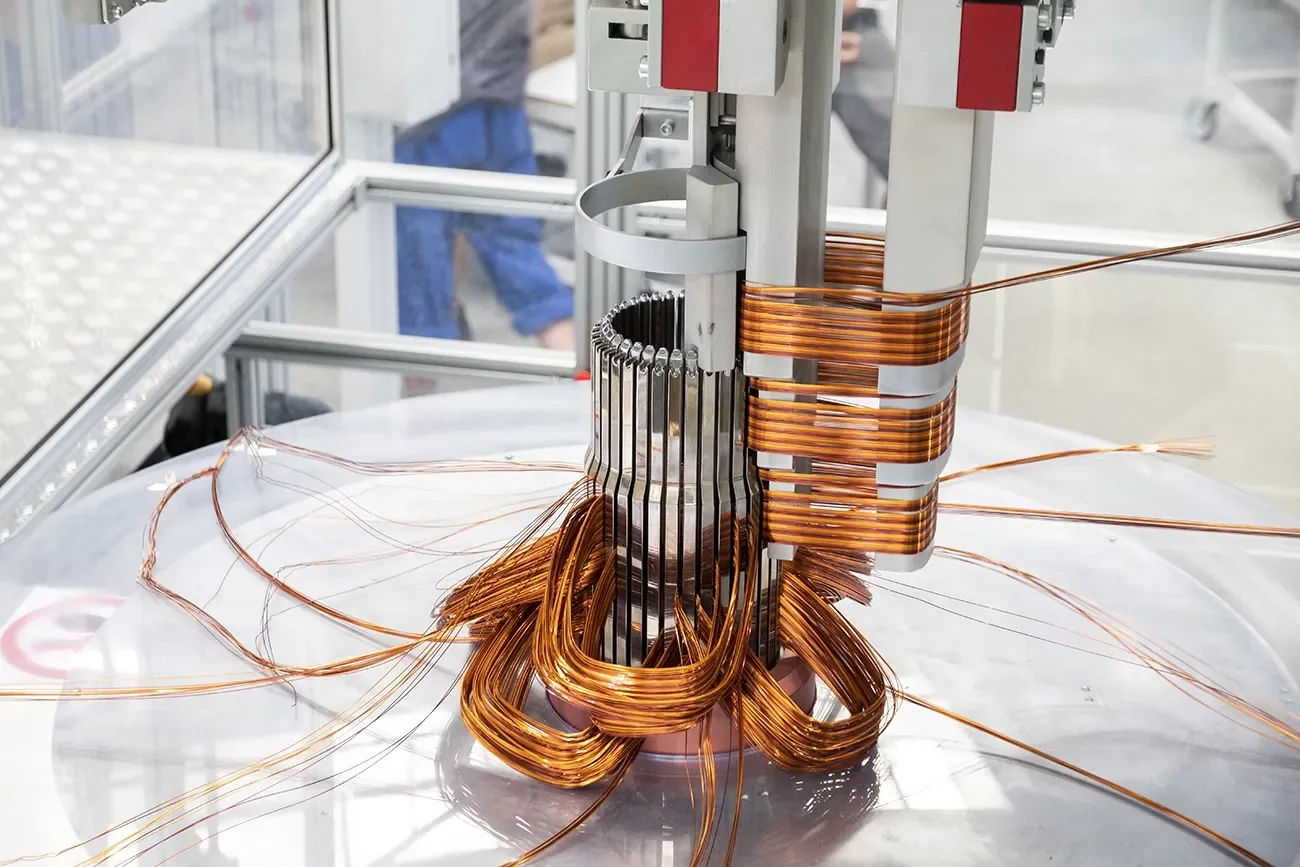
Electric motors, generators and transformers all rely on windings: coils of copper wire, usually enameled, wound turn after turn around a stator, a rotor pole or a bobbin. Coil winding machines do this at high speed, often with several winding heads running in parallel, and every turn has to be laid exactly where it belongs.
Throughout the process, one parameter conditions all the others: wire tension. Set by a tensioner, guided by pulleys and by the wire guide, it changes constantly as the wire accelerates, slows down and changes direction, turn after turn.
A winding process is only as good as its tension control
Wire tension directly affects the integrity of the insulation, the geometry of the winding, the assembly of rotors and stators, the stability of the process and, in the end, the quality of the finished product.
Too much tension can damage the enamel insulation. Too little compromises the winding geometry: dimensional defects appear, and the rotor or stator becomes harder to assemble.
Since tension varies throughout the cycle, a correct average is not enough. What matters is what happens at every turn, peaks included.
How much tension is right depends on the wire. Magnet wire makers publish a recommended window for each size, and it narrows quickly as the wire gets thinner.
Wire tension is still checked at standstill
Today, wire tension is often controlled manually, offline, in a static regime: the machine is stopped, a scale is hooked onto the wire, a value is read and the tensioner is adjusted.
The check is useful, but it is only a snapshot. Defects are born while the machine is running: during accelerations and changes of direction, turn after turn, pole after pole. A static measurement cannot show tension peaks, variations from one turn to the next, differences between two winding heads with the same settings, or the slow drift of a machine over the weeks.
How long does a drift stay invisible? It depends on how finely you measure.
Machine stopped0Drift+0.00N0.20N/h
- Dragonfly® · 0.05 N
- Manual check · 2 N
- Recommended window
- Seen by Dragonfly® at
- –
- Seen by a 2 N check at
- –
- Rotors wound in between
- 0
- Value wound blind
- €0
The real challenge is to measure what the machine is actually doing, not just what it is commanded to do. Winding quality starts with controlling the wire dynamically, throughout the process.
Dragonfly® turns the winding machine into a measurement system
Dragonfly® is the world’s thinnest and most sensitive dynamic strain sensor. It integrates a high-quality piezoceramic crystal into a 150 µm flexible substrate, with an IEPE module. When the crystal is deformed, it instantly generates an electrical charge: bonded to a part of the machine, it converts the faintest strain into a clean, measurable signal.
On a winding machine, Dragonfly® is bonded right where the wire works: on the feeder pulley and close to the needle. It measures the mechanical deformations caused by the running wire to follow wire tension and process dynamics, turn after turn, while the machine runs.
Wire tension
0.05 Nresolution demonstrated
- Dynamic wire tension
- Tension peaks
- Tension variations
- Process drift
Winding dynamics
0.2 Nresolution demonstrated
- Turn-by-turn behavior
- Pole-by-pole behavior
- Head-to-head comparison
- Mechanical signature of the process
Three ways to measure wire tension
| Handheld tension meter | Inline tension transducer | Dragonfly® | |
|---|---|---|---|
| When it measures | Machine stopped, between batches | Continuously | Continuously, turn after turn |
| What it sees | One value at rest | The tension at the transducer | Wire tension and winding dynamics |
| Resolution demonstrated here | 2 N | Depends on the model | 0.05 N |
| Wire path | Hooked onto the wire for the check | Rollers added to the wire path | Nothing added: bonded on existing parts |
| Machine controller | No link | Possible | KPIs over PROFINET or OPC UA |
Why Dragonfly® sees what conventional sensors miss
Measuring on a working machine without disturbing it is precisely where conventional sensors reach their limits, and where Dragonfly® makes the difference.
Exceptional sensitivity, ultra-low noise
Its inorganic piezoceramic crystal detects extremely small dynamic strains, with a noise floor 1000 times lower than that of a strain gauge. Even very weak signals are measured with an outstanding signal-to-noise ratio.
Negligible mechanical impact
Thin and flexible, Dragonfly® adds virtually no mass or stiffness to the part it is bonded to, and conforms to curved, complex and constrained surfaces. Measuring does not change the way the machine behaves.
Ultra-wide bandwidth
From very low frequencies to high-frequency transients and impacts, the same sensor captures the slow drift of a process as well as a sudden event.
Built to last
Its inorganic sensing material is designed to keep its performance over time, in demanding industrial environments. Plug and play, Dragonfly® is CE marked, lead-free and RoHS compliant.
What becomes visible during winding
Recorded throughout the cycle, the signal makes the winding process readable. Every winding head, pole and batch can tell a different story, and Dragonfly® makes it possible to compare them at every scale: head, pole, rotor, batch, day, month, year.
In practice, engineers see:
- Tension stability
- Dynamic events
- Differences between winding heads
- Differences between poles
- Batch-to-batch drift
- Long-term machine drift
This creates new capabilities at every stage in the life of a line:
- Process developmentDefine a robust process window.
- Machine commissioningCompare heads and identify mechanical differences.
- ProductionDetect drift before it becomes a quality issue.
- MaintenanceIdentify changes in machine behavior over time.
- Continuous improvementBuild a data-driven understanding of the winding process.
A simple architecture: monitor, detect, correct
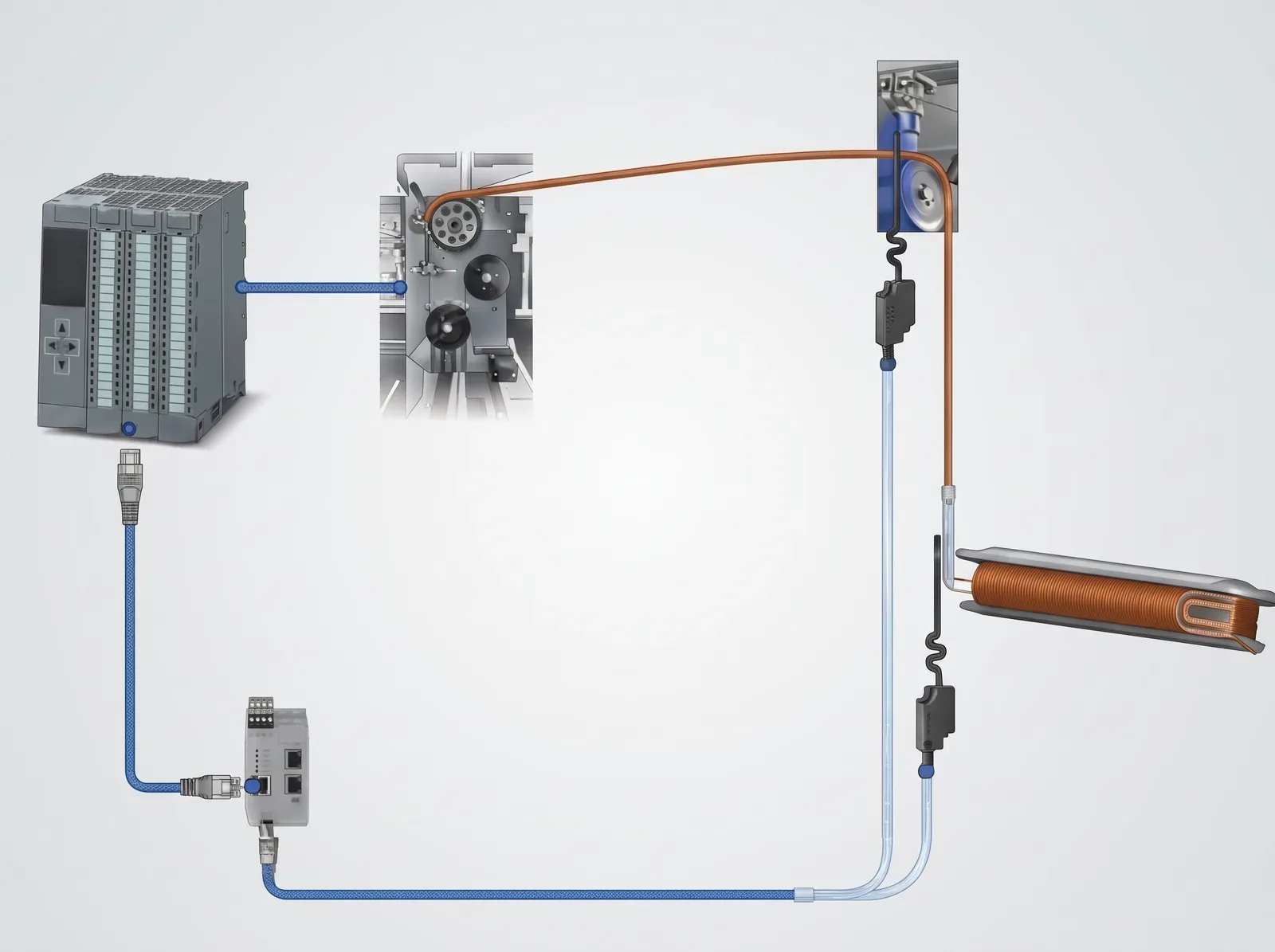
Two sensors, one acquisition system and the machine’s own controller:
Monitor
Two Dragonfly® sensors follow the wire tension and the dynamics of the winding.
Detect
The acquisition system records the signals and extracts the KPIs.
Correct
The KPIs reach the machine controller over PROFINET or OPC UA.
With the loop closed through the PLC, these signals can also adjust the tension automatically. Fewer routine checks and corrections mean more time for operators to focus on improving production.
For electric motor manufacturers: measure winding quality while it happens
Don’t inspect winding quality only at the end of the line. Measure it while it happens.
- Real-time process visibilityDetect abnormal tension.
- Process characterizationUnderstand the physical signature of a good winding.
- Early detectionIdentify deviations before they become defects.
- Closed-loop potentialFeed KPIs back to the machine controller.
- TraceabilityBuild a mechanical signature for every production process.
The business impact: less scrap, less downtime, faster process development, more stable production and better root-cause analysis.
For winding machine manufacturers: a machine ready for Industry 4.0
Built into a winding machine, Dragonfly® adds new capabilities that set it apart:
- Process monitoringMonitor wire tension dynamically.
- Machine commissioningCharacterize and compare machine heads.
- Automatic process optimizationUse physical KPIs to optimize winding parameters.
- Predictive maintenanceDetect mechanical drift before failure.
- Quality traceabilityAssociate mechanical signatures with production batches.
- Data-driven servicesEnable remote monitoring and advanced customer services.
The cost of an undetected winding problem
The cost is not the sensor. The cost is not knowing what happened inside the process.
A small mechanical deviation can interrupt a winding cycle and cause a major production loss: depending on the failure mode, it is not one part that is scrapped, but an entire batch.
Stabilize the process before a drift becomes a quality issue
With Dragonfly®, wire tension is no longer a value checked with the machine stopped: it becomes a signal followed throughout production. Teams have concrete information to adjust the settings and step in before a drift turns into a quality issue.
A better-understood process means more ways to stabilize it and limit scrap. Whether you make electric motors or design winding machines, our team can look at your application with you.
Coil winding becomes readable.
Frequently asked questions
- What is the recommended wire tension for coil winding?
- It depends on the size and material of the wire. Magnet wire makers publish a recommended window for each size, the maximum being based on the yield strength of fully annealed copper: about 26 to 35 N for a 0.81 mm copper wire (AWG 20), 2.6 to 3.5 N for a 0.255 mm wire (AWG 30). Validate the setting on your own process, so the wire is never stretched.
- How is wire tension measured during coil winding?
- Three ways: a handheld tension meter, machine stopped; an inline transducer, whose rollers the wire runs over; or Dragonfly®, bonded on the structure of the machine, which follows the tension turn after turn without adding anything to the wire path.
- Why measure wire tension while the machine is running?
- Because tension changes throughout the winding cycle, with every acceleration, change of direction and turn. A static check, machine stopped, cannot show tension peaks, turn-to-turn variations or the slow drift of a machine. Yet too much tension can damage the wire insulation, and too little compromises the winding geometry and the assembly.
- How does Dragonfly® measure wire tension on a winding machine?
- Dragonfly® is bonded directly to the machine, for example on the feeder pulley and close to the needle. Its piezoceramic crystal converts the deformations caused by the running wire into an electrical signal, which a data acquisition system turns into KPIs.
- What measurement resolution has been demonstrated?
- 0.05 N on dynamic wire tension, against 2 N for a manual check at rest, and 0.2 N on the forces related to winding dynamics.
- Can the measurements reach the machine’s PLC?
- Yes. The DAQ extracts KPIs and sends them to the PLC over PROFINET or OPC UA, which opens the way to closed-loop control of wire tension.
- Does the sensor change the behavior of the machine?
- No. At 150 µm thin and flexible, Dragonfly® adds virtually no mass or stiffness to the part it is bonded to.
- Who is this solution for?
- Electric motor manufacturers who want to control winding quality during production, and winding machine manufacturers who want to offer process monitoring, commissioning tools, predictive maintenance and traceability on their machines.