

Gustave Eiffel University (LBMC)
Split Hopkinson pressure bar
Redefining Split Hopkinson pressure bar testing with Dragonfly®
At Gustave Eiffel University (LBMC), two Dragonfly® sensors on the incident bar of a split Hopkinson pressure bar gave an almost perfectly overlaid response, validating the bench and highlighting a problem in the classic strain gauge bridge. Recorded directly, without conditioners, and installed in 20 minutes.
The challenge
The Split-Hopkinson Pressure Bar (SHPB) test is a widely recognized method for analyzing material behavior under high strain rates. The test involves generating an impact in an input bar, which transmits compression waves through the sample under investigation. The strain response, typically measured using strain gauges, can be as low as 0.5 µm/m, approaching the detection limit of conventional foil gauges.
Even with an optimally configured test bench, any misalignment in the bonding of measurement and compensation gauges can significantly degrade signal quality. Additionally, before each experiment, temperature-induced bridge drift must be carefully compensated.
To capture these signals, which are sampled at 5 MHz, the setup requires high-frequency, costly signal conditioners and exceptionally high strain sensitivity.
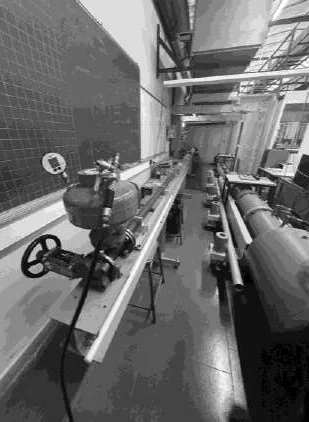
Precise instrumentation setup
The proper full bridge gauge alignment can dramatically influence the results.
Measurement noise
Highly sensitive sensors are required to accurately capture the transmitted signal responses at high frequencies.
Conditioner costs
High frequency Wheatstone bridge conditioners are needed when data is acquired in MHz bandwidth.
Breaking point
Measuring extremely small strain levels in Split-Hopkinson Pressure Bar (SHPB) tests is a major challenge. Standard strain gauges operate at the edge of their accuracy limits, requiring costly high-frequency conditioning equipment to maintain acceptable noise levels.
Wormsensing's ultra-sensitive, passive sensor provides a breakthrough alternative, simplifying system integration, reducing complexity and enhancing overall usability, while delivering unmatched precision in high-strain rate experiments.
We asked Gustave Eiffel UniversityWhat is the key benefit of using Dragonfly®?
Dragonfly® signal response validated the bench quality and highlighted a problem in our classic strain gauge bridge instrumentation.
The solution
Dragonfly® is a revolutionary strain sensor delivering 1000x more resolution than a traditional strain gauge, enabling high accuracy, passive, conditioner-free strain measurement on split Hopkinson pressure bars.
Discover Dragonfly®Range precision
Dragonfly® can capture high range and tiny deformation caused by the compressive pulses.
Passive
Instrumented and recorded directly without costly conditioners.
Zero drift
Can be bonded on curved surfaces and doesn't need compensation for temperature drifts.
Key features
- Sensitivity
- 1000×More sensitive than traditional sensors
- Signal to noise ratio
- >120 dBExtremely low noise level
- Measurement range
- ±3000 µm/mAbove steel plasticity
- Integration
- Plug & PlayVoltage, charge, IEPE standard
The evidence
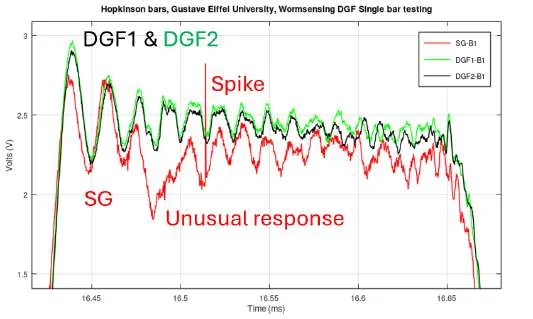
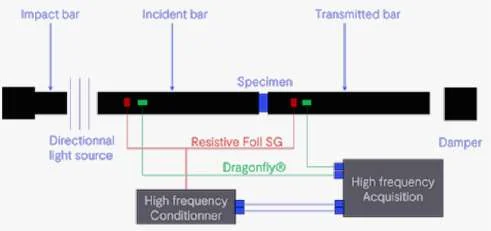
Two Dragonfly® sensors, installed on the upper and lower sides of the incident bar (green and black curves), exhibit an almost perfectly overlaid response, confirming both the compressive nature of the wave and the high geometric accuracy of the test bench.
In comparison, the classic strain gauge bridge response (red curve) appears noisier, highlighting an instrumentation issue within the setup.
Tests conducted with a foam sample demonstrated equal or superior performance compared to a high-frequency full bridge system (2 MHz). The direct Dragonfly® output, without conditioning, further validates the potential for cost reduction by a factor of 5 to 10 while maintaining high measurement fidelity.
Dragonfly® versatility extends to
- Wind Turbines
- Automotive
- Infrastructures & Bridges
- Transportation
Next step
Get the Dragonfly® kit for your test bench.
© 2025 Wormsensing. Redefining Split Hopkinson pressure bar testing with Dragonfly®, PDF, 2 pages, 2.0 MB.