

Airbus Defence and Space
Satellite vibration testing
Setting new standards in satellite vibration testing with Dragonfly®
At Airbus Defence and Space, Dragonfly® has become a reference strain sensor for satellite vibration testing: direct, high-accuracy strain measurement at critical satellite interfaces, with 1000x more resolution than a traditional strain gauge.
The challenge
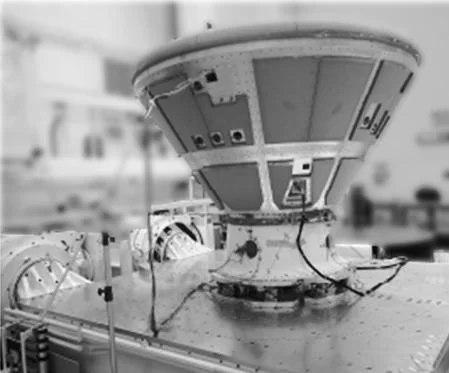
Today's satellite vibration testing faces challenges in accurately simulating the harsh conditions of launch, as vibrations and loads can vary widely across different rocket types and mission profiles. High testing costs and the need for precise validation methods are additional hurdles requiring advanced modeling and specialized facilities. Additionally, satellite components are becoming smaller and more complex. Ensuring their resilience without adding excess weight while maintaining functionality remains a significant design challenge.
High instrumentation costs
Force Limited Vibration Testing (FLVT) method can lead to changes in the structural behavior and requires substantial investment in instrumentation.
High uncertainty
The current shaker coil method, with an estimated 10% uncertainty, is often misaligned with real-time dynamics.
Simulation errors
Simulations based on acceleration in FEM models can bring mismatch errors of up to 10%, leading to inaccuracies in predictive analysis.
Breaking point
With increasing requirements for precision in satellite vibration testing, traditional testing methods became impractical. Tracking sensor calibrations, maintaining accuracy across tests, and handling growing volume of various data sets result in inefficiencies. Dragonfly® strain sensors emerged as Airbus D&S' go-to solution, setting a new standard by delivering consistent, accurate measurements essential for reliable satellite performance.
We asked Airbus Defence & SpaceWhat changed with Dragonfly®?
Dragonfly® has challenged 30 years of vibration testing, bringing new levels of precision and removing sources of errors. Dragonfly® has become a reference strain sensor at Airbus D&S to conduct satellite vibration testing.
The solution
Dragonfly® is a revolutionary strain sensor delivering 1000x more resolution than a traditional strain gauge, enabling direct, high-accuracy strain measurement at critical satellite interfaces, eliminating the need for complex and error prone simulations.
Its ease of installation and integration will also allow for increased efficiency in test preparation and extra robustness during measurements.
Discover Dragonfly®Direct installation
Easily mounted onto critical interfaces without affecting the satellite's design integrity or behavior.
Direct measurement
Provides precise stress data, bypassing error-prone simulations with strain signal quality comparable to accelerometers.
Simplified instrumentation
Dragonfly® uses compact, microdot coaxial cabling compatible with IEPE/ICP systems, reducing installation time and costs.
Key features
- Sensitivity
- 1000×More sensitive than traditional sensors
- Signal to noise ratio
- >120 dBExtremely low noise level
- Measurement range
- ±3000 µm/mAbove steel plasticity
- Dynamic range
- 0.01 Hz to >100 kHzFrom quasi-static to ultrasound
- Integration
- Plug & PlayVoltage, charge, IEPE standard
The evidence
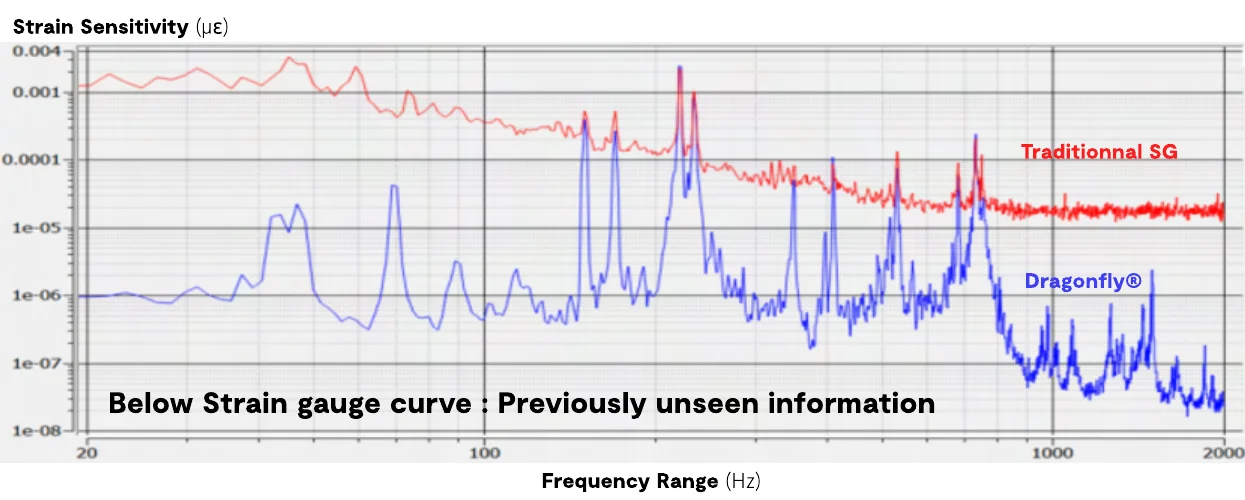
The signal from Dragonfly® sensors (in blue) provides a deeper, more detailed understanding of the phenomenon being measured compared to traditional strain gauges (in red).
Dragonfly®'s higher sensitivity allows it to capture more subtle signals with a great signal quality, providing insights that were previously inaccessible.
Dragonfly® versatility extends to
- Wind Turbines
- Automotive
- Infrastructures & Bridges
- Transportation
Next step
Get the Dragonfly® kit for your test bench.
© 2024 Wormsensing. Setting new standards in satellite vibration testing with Dragonfly®, PDF, 2 pages, 2.4 MB.