

VIBRATEC
Force reconstruction
Unmatched accuracy in force reconstruction with Dragonfly®
Inverse methods reconstruct the forces acting on a structure from its measured responses. VIBRATEC's latest use case, with extremely low strain amplitudes, could only be addressed with Dragonfly®: 1000x the resolution of traditional gauges, a large measuring range and end-to-end shielding.
The challenge
Inverse methods are used in both design and operation to reconstruct underlying forces from structural responses, especially when direct measurements are impractical. This approach relies on two key steps: calibration and operation.
During calibration, measured responses can be weak due to structural stiffness, particularly when applied forces are distant from measurement points. To optimize sensor placement, Finite Element Modeling (FEM) helps identify locations with the highest strain or acceleration.
Traditional methods, such as accelerometers, struggle with force correlation and low sensitivity in the low-frequency domain. Foil strain sensors suffer from noise, leading to force reconstruction errors. As a result, more sensors are often required, increasing both setup cost and complexity.
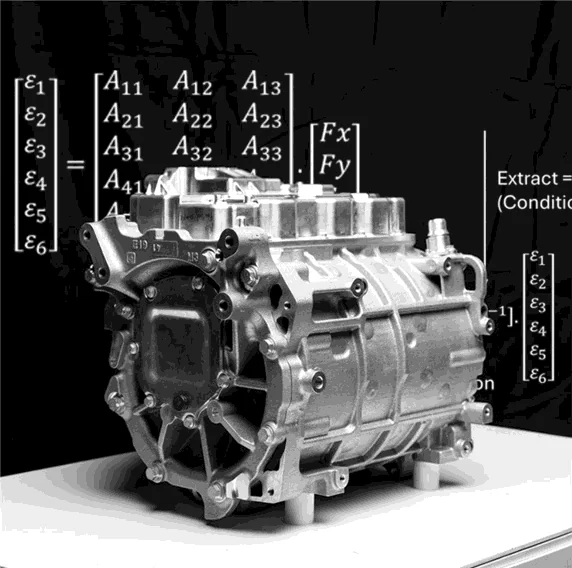
Sensor sensitivity is critical
The sensor sensitivity and signal to noise ratio need to be maximized during the calibration phase.
Sensor range limitation
To accurately capture the structure response both during calibration, where responses can be weak, and at higher levels during operation, a sensor with a wide dynamic range is essential.
Acceleration inappropriate
Accelerometers are sensitive but acceleration is not proportional to the forces in the structure.
Breaking point
Recent industrial methodologies simulate transfer paths in multi-component assemblies, requiring individual measurement of forces at system interfaces, whether acting as source components or passive receptors, following ISO 20270 standards. Achieving high-quality datasets in this context demands ultrasensitive sensing with very low noise and high electromagnetic field (EMF) protection.
We asked VIBRATECWhat is the key benefit of using Dragonfly®?
Our latest use case, which involved extremely low strain amplitudes, could only be successfully addressed thanks to the Dragonfly® sensors from Wormsensing.
The solution
Dragonfly® is a revolutionary strain sensor that offers 1000x the resolution of traditional gauges, enabling high accuracy, low noise, high immunity to EMF, great integrability and frequency bandwidth, making it the perfect fit for force estimation in inverse methods.
Discover Dragonfly®Precision
1000x more sensitive than strain gauges, Dragonfly® ensures unmatched accuracy in every calibration.
Versatility
Captures both micro-deformations and large-scale shifts with seamless adaptability to any measurement need.
Force correlation
Measures strain with absolute precision, providing a direct reading of applied forces for a clearer structural analysis.
Key features
- Sensitivity
- 1000×More sensitive than traditional sensors
- Signal to noise ratio
- >120 dBExtremely low noise level
- Measurement range
- ±3000 µm/mAbove steel plasticity
- Integration
- Plug & PlayVoltage, charge, IEPE standard
The evidence
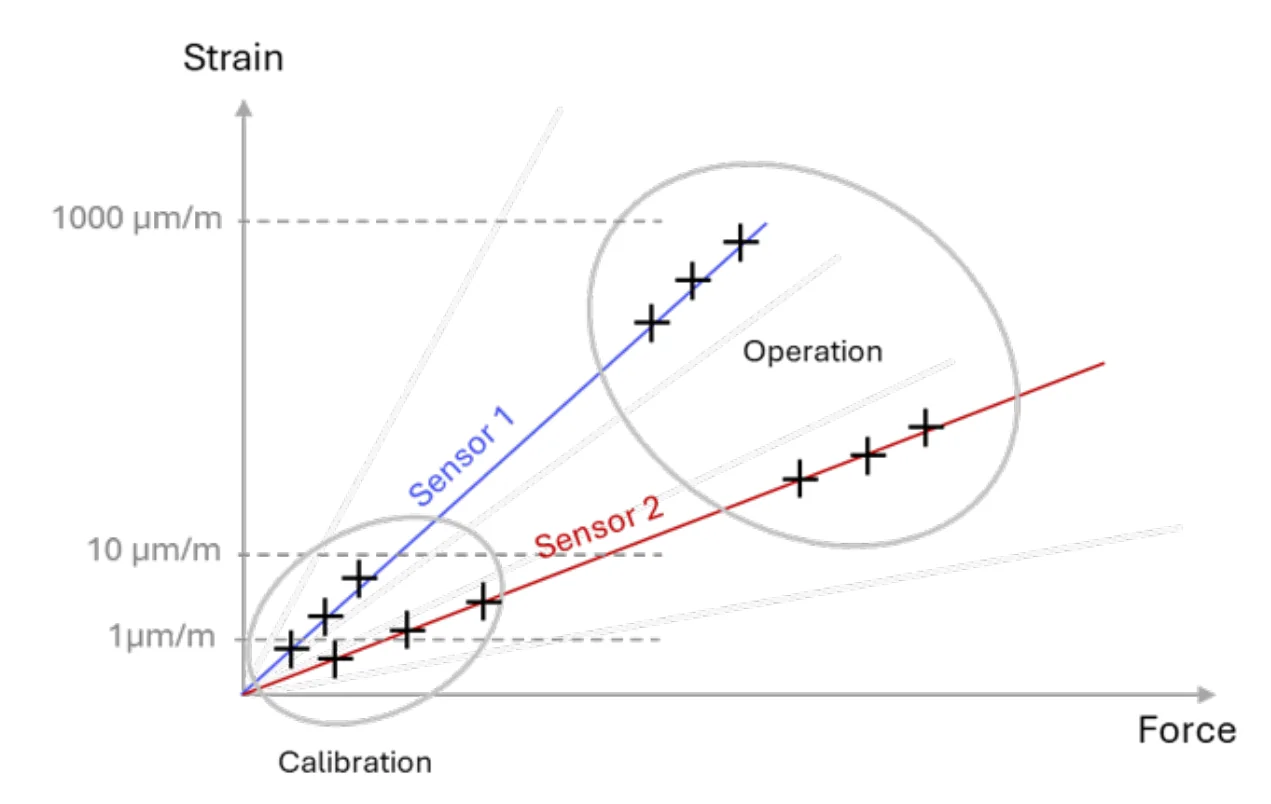
Dragonfly® revolutionizes inverse methodologies by offering ultra-high resolution measurements during calibration while maintaining the ability to capture high-amplitude responses during operation, thanks to its large measuring range.
Its end-to-end shielding, exceptional sensitivity and high signal-to-noise ratio set it apart from traditional foil strain gauges, ensuring superior measurement quality.
In contrast to acceleration-based methodologies, which exhibit weak responses at low frequencies, strain-based measurements provide a more reliable correlation with applied forces, making them the preferred choice for accurate force reconstruction.
Dragonfly® versatility extends to
- Wind Turbines
- Automotive
- Infrastructures & Bridges
- Transportation
Next step
Get the Dragonfly® kit for your test bench.
© 2025 Wormsensing. Unmatched accuracy in force reconstruction with Dragonfly®, PDF, 2 pages, 2.4 MB.