

CREA, research center of the French Air and Space Force Academy
Airflow on structures
Measuring the influence of airflow on structures using Dragonfly®
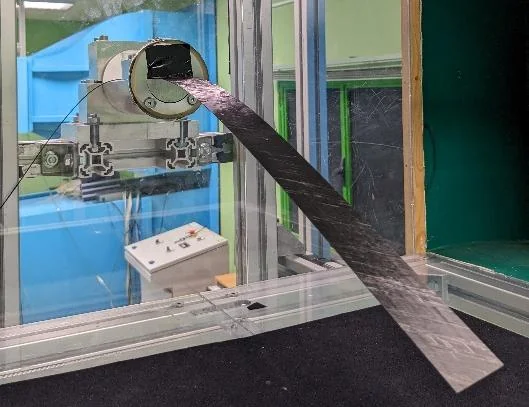
In wind-tunnel testing at CREA, the research center of the French Air and Space Force Academy, Dragonfly® captures both the low-frequency deformations and the high-frequency vibrations of the structure without disturbing the airflow, with a performance comparable to state-of-the-art accelerometers. It was installed in 10 minutes.
The challenge
Wind tunnel measurements are regularly carried out to investigate the influence of an airflow on structures. Aeroelasticity is a field of mechanics where the interaction between the airflow and the structure is studied, to predict and avoid instabilities.
Wind tunnel measurements of aeroelasticity phenomena are challenging because accurate information on the structure must be gathered without disturbing the airflow.
Airflow disturbances
Bulky sensors like accelerometers may dramatically influence the results.
Measurement noise
Highly sensitive sensors are required to accurately capture the structure's movement.
Installation time
Wind tunnels are expensive equipment and installation time must be reduced to the minimum.
Breaking point
Increasing constraints on vehicle weight due to fuel consumption reasons drive engineers to manufacture more flexible structures which are more prone to flutter and other fluid-structure interaction instabilities. This increases the demand for reliable and cost-efficient wind-tunnel experiments like for example gust response measurements.
To reduce the cost of testing, the instrumentation should be faster to install, without compromising on the accuracy and reliability.
We asked The research center of the French Air and Space Force AcademyWhat is the key benefit of using Dragonfly®?
Dragonfly both captures the low frequency deformations and the high frequency vibrations without disturbing the airflow.
The solution
Dragonfly® is a revolutionary strain sensor delivering 1000x more resolution than a traditional strain gauge, enabling direct, high accuracy strain and vibration measurements of structures during wind-tunnel testing.
Discover Dragonfly®Zero disturbance
Thin and flexible: can be installed anywhere without disturbing the airflow.
Highest sensitivity
Dragonfly® can capture vibrations that traditional strain gauges miss.
Plug & Play
Compact, microdot coaxial cabling and IEPE interface reduce installation time and costs.
Key features
- Sensitivity
- 1000×More sensitive than traditional sensors
- Signal to noise ratio
- >120 dBExtremely low noise level
- Measurement range
- ±3000 µm/mAbove steel plasticity
- Integration
- Plug & PlayVoltage, charge, IEPE standard
The evidence
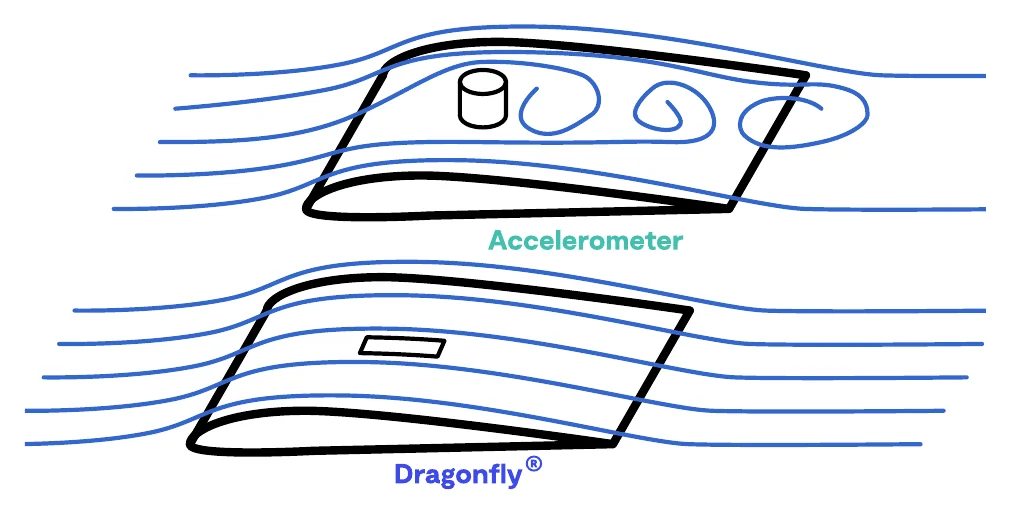
Dragonfly® strain sensors have a flat form factor (less than 200 µm thick). They can be installed anywhere on the structure without affecting the measurement quality or disturbing the flow.
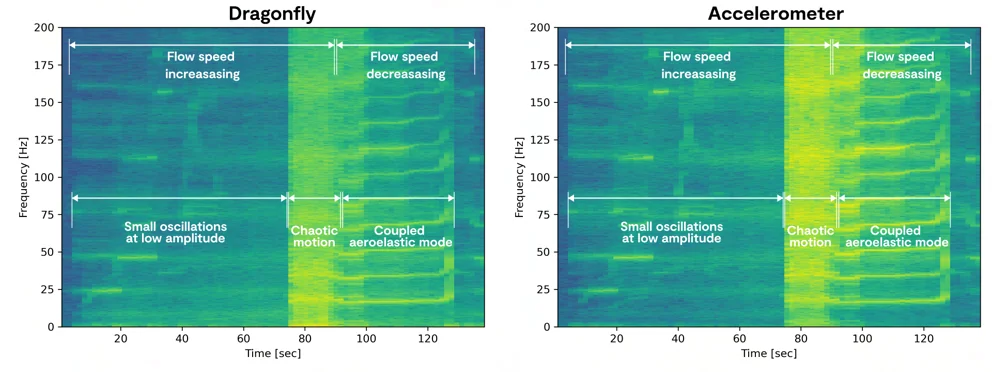
In the spectrograms, the wing first oscillates at low amplitude, then reaches flutter which is chaotic first, with energy distributed at all frequencies, and finally oscillates in a limit cycle with numerous distinguishable harmonics. These diagrams illustrate the comparable performance of Dragonfly® to state-of-the-art accelerometers, while avoiding the drawbacks of negative airflow impact, leading to more accurate measurement insights.
Dragonfly® versatility extends to
- Wind Turbines
- Automotive
- Infrastructures & Bridges
- Transportation
Next step
Get the Dragonfly® kit for your test bench.
© 2025 Wormsensing. Measuring the influence of airflow on structures using Dragonfly®, PDF, 2 pages, 2.5 MB.